
A professional website is your hardest-working employee. It is out there 24/7, finding new customers, answering their questions and building trust in your brand. For any small business in the UK, it is one of the most vital investments you can make.
Why Your Website Is Your Hardest-Working Employee
Forget the idea that a website is just an online brochure. After working on over 200 projects, we have seen first-hand that a well-designed site is a powerful engine for growth. It is your digital shopfront, your top salesperson and your customer service team all rolled into one. It should be the absolute centre of your marketing universe.
Think about the last time you needed a service. Did you flick through the Yellow Pages? I doubt it. You almost certainly searched online. Well, your customers are doing the exact same thing. A professional, easy-to-use website is what makes you stand out and gives people the confidence to pick up the phone.
More Than Just a Pretty Page
A great website is about so much more than just looking good. It has a job to do. Specifically, it needs to be:
A Lead Generator: It should be actively capturing details from potential customers through clear contact forms and compelling calls to action.
A Trust Builder: It is your chance to show off your expertise, customer reviews and professional accreditations to prove you are the real deal.
An Information Hub: It can answer all the common questions you get asked, saving you countless hours on the phone or replying to emails.
The numbers do not lie. As of 2025, a massive 73% of small businesses now have a website, which just goes to show how essential it has become. If you are interested in the data behind this, Network Solutions has some great statistics. This shift proves that a strong online presence is not a ‘nice to have’ anymore; it is a fundamental part of running a successful business.
For us, the biggest win is seeing a client’s website start generating enquiries all by itself. We recently worked with a local tradesperson in Southampton who saw a 250% increase in qualified leads within just three months of their new site going live. That is the power of turning a simple website into a proper growth machine.
This kind of transformation does not happen by accident. It is the result of a clear plan that perfectly aligns your website with your business goals. For more on this, check out our guide on creating a marketing strategy for small businesses.
Ultimately, investing in thoughtful website design for small business uk is not a cost. It is one of the smartest moves you can make for your company’s future.
Mapping Out Your Website Before You Build
It is tempting to jump straight into the fun stuff, like picking out colours and templates. I have seen it happen countless times. But trust me, the most valuable work you can do happens long before you even look at a design. Taking the time to properly map everything out first will save you a world of headaches, time and money later on.
The very first question to ask is a simple one: what is this website for? Its core purpose will dictate every single decision that follows. Are you trying to get potential clients to fill out an enquiry form? Is it a full-blown online shop built to sell products? Or is it more of a digital brochure, designed to provide information and build trust in your brand?
Once you nail down that goal, you know what success looks like. It is the difference between tracking the number of online sales versus the number of phone calls your business receives.
Know Your Audience and Their Journey
Okay, so you know what you want your site to do. Now, who is it for? Get a clear picture of your ideal customer. What problem are they trying to solve when they land on your website?
Thinking about their needs helps you lay out a clear path for them to follow. For example, a homeowner in a panic over a burst pipe needs your phone number and service area front and centre. No messing about. Someone looking for a business coach, on the other hand, will likely want to read a few case studies or blog posts before they even think about getting in touch.
Understanding this path is everything. It is a process often called customer journey mapping and it is fundamental to building a site that actually works for your business.
This infographic neatly shows how a website's role can shift from being a simple online leaflet to a genuine tool for growth.
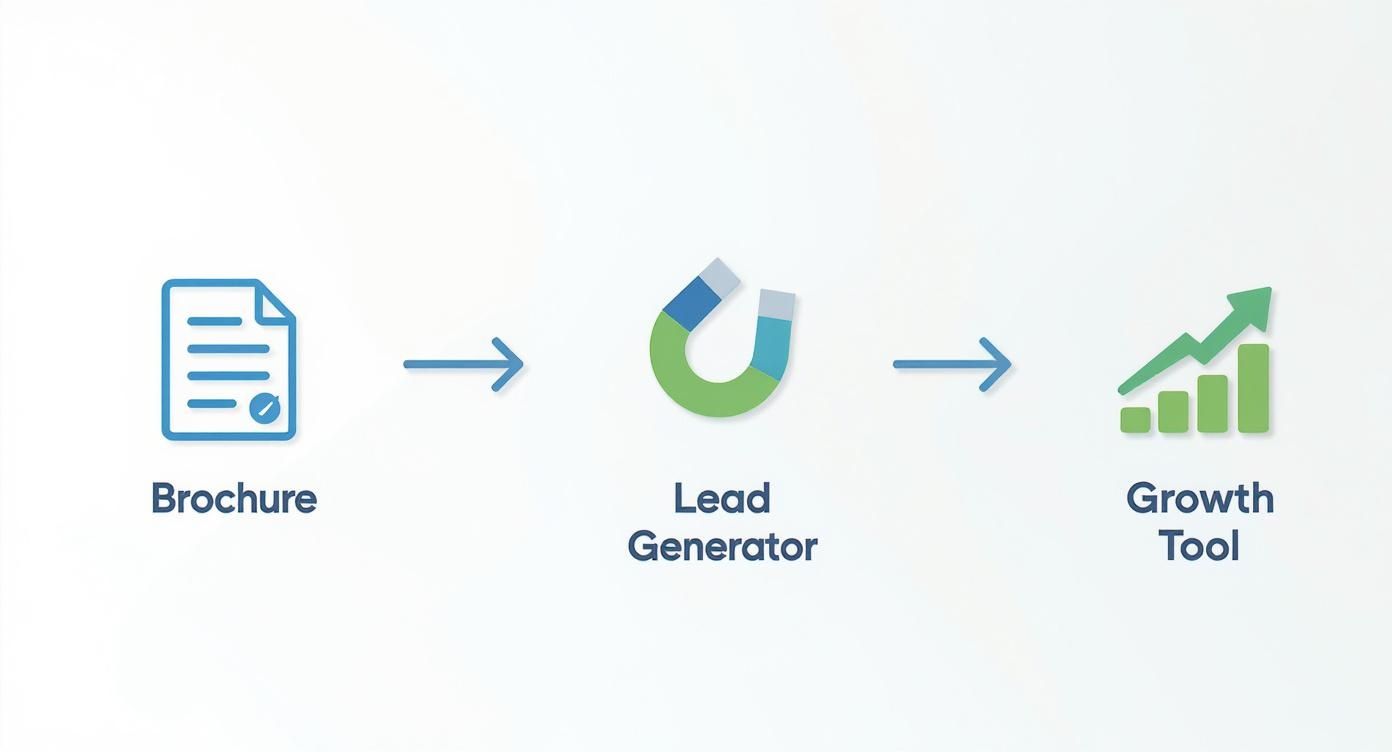
As you can see, the idea is for your website to be an active part of your business development, not just a static document left to gather digital dust.
Creating a Simple Sitemap
With your goal and audience in mind, you can start sketching out the actual pages. This plan is called a sitemap, but do not let the technical term put you off. It can be as simple as a list of essential pages needed to guide your visitors.
For most UK small businesses, the sitemap will include a few core pages:
Home: Your digital front door. It needs to clearly state who you are, what you do and who you help.
About Us: Tell your story. This is your chance to build a real connection and earn visitors' trust.
Services/Products: A detailed breakdown of your offerings. No ambiguity here.
Contact Us: Make it ridiculously easy for people to reach you. Phone, email, form (give them options).
Think of a sitemap as the blueprint for a house. You would not let a builder start laying bricks without one, would you? The same goes for your website. A clear plan ensures every page has a logical place, making it easy for visitors to find exactly what they need.
Getting these fundamentals right is a non-negotiable part of effective website design for small business uk. It ensures your finished site is built on a solid, strategic foundation.
Choosing the Right Platform for Your UK Business
So you have got your plan nailed down. Brilliant. Now for one of the biggest decisions you will make: choosing the foundation your website will be built on.
This choice will shape everything from your monthly running costs to how easily your site can adapt as your business grows. Do not let the technical jargon overwhelm you. The "best" platform is simply the one that aligns with your budget, your technical comfort level and what you want to achieve.
For most small businesses in the UK, the decision usually comes down to three heavyweights: WordPress, Shopify and Squarespace. Each one has its own personality and is built for a different kind of business owner. Getting this right is a cornerstone of effective website design for small business uk.
WordPress: The Flexible All-Rounder
There is a reason WordPress powers a huge chunk of the internet. Its superpower is flexibility. You can build pretty much anything you can dream up, from a simple five-page brochure site to a sprawling, content-rich business hub. It is open-source, which is a fancy way of saying you have total freedom and control over every pixel and every feature.
That freedom is its best and worst trait. It comes with a steeper learning curve, as you will be responsible for sorting out your own hosting, security and updates. But for a service-based business that plans to grow with blogging and wants complete control, it is a powerful, long-term asset.
Shopify: The E-commerce King
If you are selling physical products, Shopify is almost certainly your best bet. It was born and bred for one thing: e-commerce. It takes the headache out of online selling by handling all the tricky stuff like payment gateways, stock control and shipping calculations right out of the box.
Sure, it is not as customisable as WordPress for general content pages, but its laser focus on selling is what makes it so good. The platform is secure, reliable and straightforward enough for a complete beginner to launch a shop. Shopify lets you focus on your products, not on tinkering with technology.
Squarespace: The Simple and Stylish Choice
Squarespace is all about aesthetics and simplicity. It is famous for its stunning, modern templates and a user-friendly drag-and-drop editor. It is an excellent choice if you need a visually impressive website without wanting to touch a line of code.
Think photographers, consultants, restaurants, or any business where looking the part is half the battle.
Here is a simple way to think about it: WordPress is a massive box of Lego with infinite possibilities. Shopify is a purpose-built shop-in-a-box kit. And Squarespace is a beautifully designed, pre-furnished room. Each is brilliant at its own job.
To help you decide, let's break down how they stack up against each other from a small business owner's perspective.
Comparing Popular Website Platforms for UK Small Businesses
This table compares the key features of WordPress, Shopify and Squarespace to help you choose the best fit for your business needs and budget.
Platform | Best For | Average Monthly Cost (UK) | Ease of Use | Scalability |
|---|---|---|---|---|
WordPress | Service businesses, blogs and custom sites | £15 - £50+ | Moderate | High |
Shopify | Selling products online (e-commerce) | £25 - £250+ | Easy | High |
Squarespace | Portfolios, creative businesses, brochures | £17 - £40 | Very Easy | Moderate |
In the end, there is no magic "best" platform for everyone. The right choice is deeply personal to your business. Think about what you need right now, but also have a glance at the horizon and consider where you want to be in two or three years. That foresight will help you pick a foundation that can truly grow with you.
Designing a Site That Your Customers Will Love
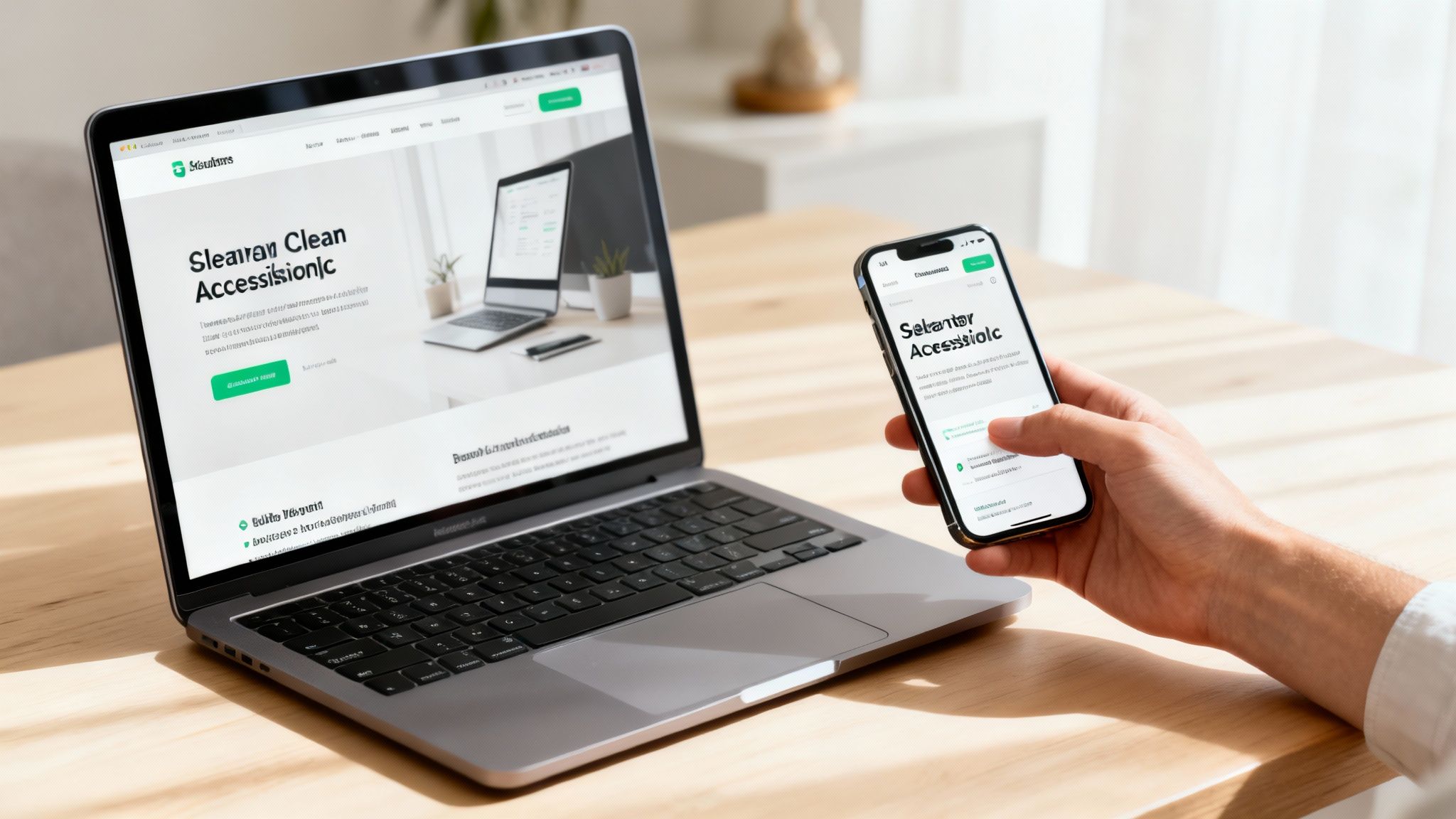
Let's be honest, a great website design is not really about winning awards or using the trendiest new colour palette. It is about making your website dead simple for your customers to use. If someone lands on your site and cannot figure out where to go or what to do within a few seconds, they are gone. It really is that simple.
Over the years, I have seen this play out time and time again. The small businesses that thrive online are always the ones that put clean layouts and intuitive navigation first. Think of your website as a tool with a job to do; good design helps it do that job without any fuss.
Make It Simple and Clear
Often, the most effective designs are the ones you do not even consciously notice. They just work, guiding you seamlessly from one page to the next. For your small business site, this boils down to a few fundamental ideas.
Clean Layout: Do not be afraid of white space! A cluttered page is a confusing page, making it impossible for visitors to focus on what you actually want them to do.
Simple Navigation: Keep your main menu logical and predictable. Use familiar terms people expect, like ‘Home’, ‘About Us’, ‘Services’ and ‘Contact’.
Obvious Calls-to-Action: Your buttons need to spell out the next step. Phrases like ‘Get a Free Quote’ or ‘Book a Consultation’ leave no room for doubt.
Confusion is the enemy. It is one of the biggest reasons people abandon a website. A clear, straightforward path is non-negotiable.
Design for Mobile First
Here is the reality in the UK today: most of your customers will first visit your website on their phone. This is not a future prediction; it is happening right now. That means your site absolutely must look and perform perfectly on a small screen.
This approach is called responsive design, it means the website automatically adapts its layout to fit any device, from a huge desktop monitor down to the smallest smartphone. When we build a site for a client, we always design the mobile experience first. Why? Because if it works brilliantly on a phone, scaling it up for a desktop is a piece of cake.
A website that is a nightmare to use on a mobile is like having a shop with a door that is too small for most people to get through. You are turning customers away before they have even had a chance to see what you offer.
Accessibility Is Good for Everyone
Making your site accessible is about ensuring people with disabilities can use it without barriers. But here is the secret: the improvements you make for accessibility end up making the experience better for all of your visitors.
Simple things, like using clear, legible fonts and having strong colour contrast, help everyone read your content more easily. The data backs this up, with 60% of users saying usability is the single most important feature of a website's design. To truly get this right, you need a solid grasp of User Experience Design Fundamentals, which puts the user at the centre of every decision. This is not just a box-ticking exercise anymore; it is a crucial part of building trust and credibility with your audience.
Launching Your Website and Getting Found on Google
Getting your website built and ready is a massive milestone. It is a great feeling, but the job is not quite finished when the design gets signed off. In fact, launching your site is really just the beginning, it is where the work of winning new customers truly starts.
Think of it like opening a new high-street shop. You would not just unlock the door on day one and hope people magically wander in. You need to put a sign up, maybe run a local promotion and let everyone know you are open for business. Your website is no different.
Your Pre-Launch Checklist
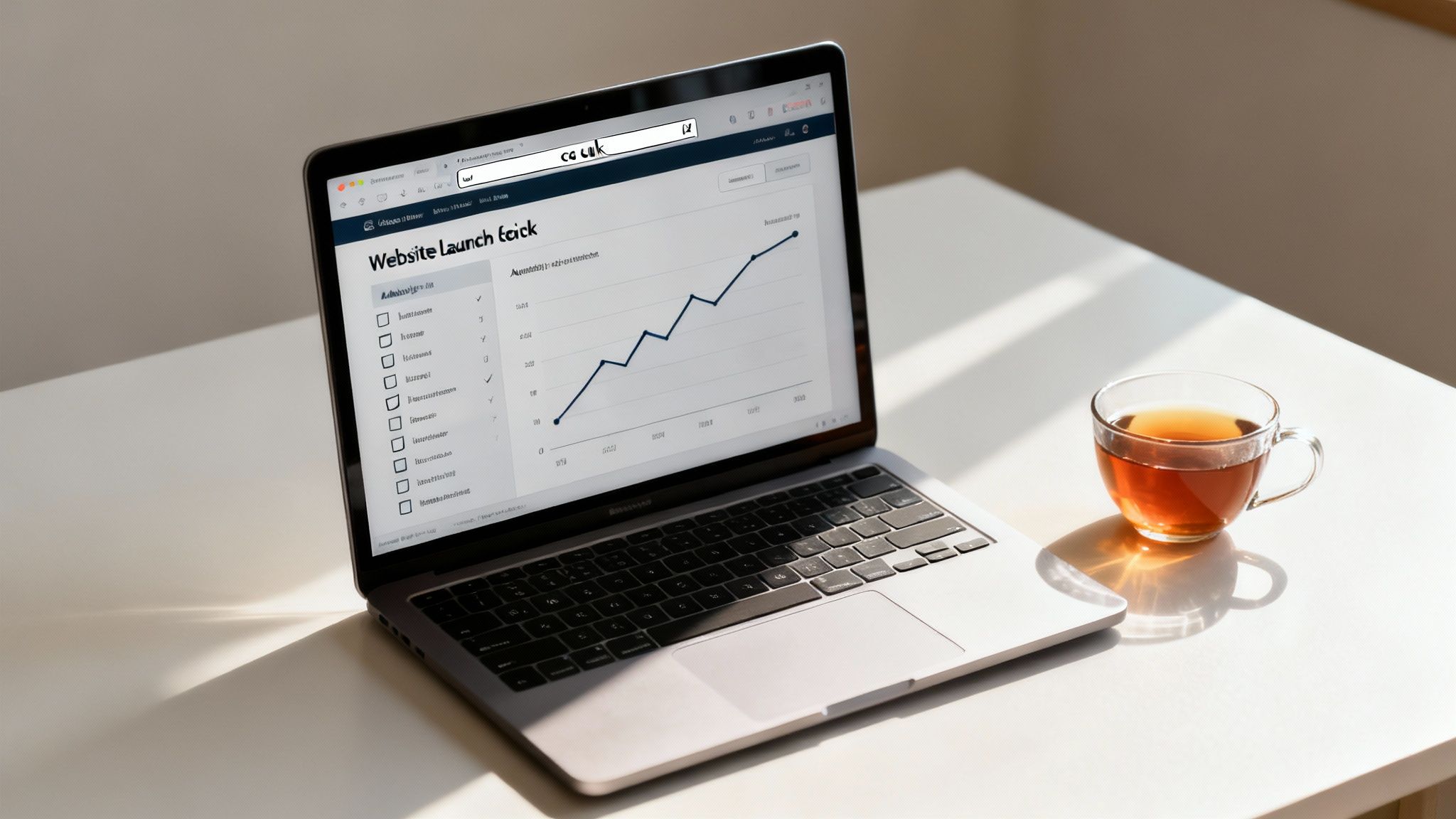
Before you shout about your new site from the rooftops, it is absolutely vital to run some final checks. It is so easy to get carried away with excitement and rush this bit, but believe me, a few minutes of testing now will save you from making a terrible first impression on potential customers.
Here are the non-negotiables we go through for every single one of our clients' sites:
Test every single link and button. Click on everything. Make sure your menu items, contact buttons and internal links all go to the right place. A broken link is an instant trust-killer for a visitor.
Check your contact forms. Please, do this. Fill out your own enquiry form and make sure the message actually lands in your inbox. This is often the main goal of the website, so it has to work flawlessly.
View it on your mobile. Seriously, grab your phone and browse the entire site as if you were a customer. Does it look right? Is the text easy to read? Can you actually tap the buttons without zooming in? This is how most people will see your site.
Once these basics are covered, you are ready to push the big green "go live" button. This is just the start of your journey into making website design for small business uk actually work for you.
Making a Good First Impression on Google
Right, your site is live. Now you need to help search engines like Google understand what it is all about. This whole process is called Search Engine Optimisation, or SEO. It might sound intimidating and technical, but the fundamentals are surprisingly straightforward.
Try to see it from Google’s point of view. It simply wants to show its users the most relevant, helpful results for whatever they are searching for. Your job is to make it crystal clear that your website is the perfect answer for someone looking for your services in the UK. The ultimate goal is to get found, which often involves learning how to rank higher on Google.
Do not get overwhelmed by SEO. At its heart, it is about being helpful. If you create pages that clearly answer the questions your customers are asking, you are already halfway there. Google's main goal is to satisfy its users, so focus on them first.
Here are a few simple things you can do to get the ball rolling:
Write clear page titles. The title of each page (that is the text you see in the browser tab) is one of the first things Google reads. Make sure it accurately describes what is on the page, like "Boiler Repair Services in Southampton" instead of a generic "Services".
Use your keywords naturally. Think about the words and phrases your ideal customer would type into Google. Weave these into your headlines and general text, but never force them in. Always write for humans first, not robots.
Optimise your images. Before you upload them, give your image files descriptive names (e.g.,
new-kitchen-installation-london.jpginstead ofIMG_1234.jpg). This gives Google another important clue about your content.
For many UK companies, especially those serving a specific town or county, focusing on local search is absolutely key. Getting these basics right lays a solid foundation for your website's success in the long run.
Your Website Design Questions Answered
Over the years, we have helped hundreds of small businesses get online and the same practical questions always seem to surface. It is totally normal to have a few uncertainties when you are starting out. Here are some straightforward answers to the questions we hear the most, pulled directly from our experience in the field.
How Much Should a Small Business Website Cost in the UK?
This is always the first question and the honest answer is: it really depends. You could get started with a DIY website builder like Squarespace for as little as £20 to £40 a month. For a brand new business just finding its feet, this can be a perfectly sensible first step.
At the other end of the scale, a custom website from a professional agency could be anywhere from £2,000 to £9,000, sometimes more. The final figure hinges on complexity. Things like a built-in online shop or a custom booking system will naturally increase the price.
The key is to think of it as an investment, not just a cost. A cheap website that does not bring in a single new customer is a waste of money. A great one can pay for itself many times over.
How Long Does It Take to Build a New Website?
Again, this comes down to the size of the job. A small, simple brochure-style site with just a few pages can often be turned around in about 4 to 6 weeks. It is a pretty streamlined process when the scope is clear from the start.
If you are looking at something more substantial, like a full e-commerce shop or a site with unique features, you are probably looking at a timeline closer to 12 to 16 weeks. In our experience, the single biggest thing that slows a project down is waiting for the client to supply the text and photos. If you have your content ready to go from day one, you will fly through the process.
A website is a partnership. The faster a client can provide feedback and content, the faster we can build their new site. Clear communication on both sides is the secret to a smooth and speedy launch.
What Is SEO and Do I Really Need It?
SEO means Search Engine Optimisation. Put simply, it is the art and science of getting your website to appear higher up in Google's search results when people are looking for the services you offer. And to answer the second part of the question: yes, you absolutely need it.
Think of it this way: a beautiful website without SEO is like a fantastic shop tucked away on a side street with no sign. Nobody will ever find it. Good website design for small business uk has to bake SEO in from the very beginning. It is what ensures that when a potential customer searches for what you do, your business actually shows up.
Do I Need to Pay for Ongoing Website Maintenance?
Yes, factoring in ongoing maintenance is crucial for protecting your investment. A website is not a "set it and forget it" asset. It is a living part of your business that needs regular attention to keep it secure and performing well.
This typically covers:
Security updates to shield your site from hackers and malware.
Software updates for all the behind-the-scenes plugins and tools.
Regular backups so your site can be quickly restored if anything goes wrong.
Most agencies offer monthly care plans that take care of all this for you. These usually run between £50 and £150 a month and give you complete peace of mind, knowing your digital shopfront is safe, secure and always online.
Ready to build a website that becomes your hardest-working employee? Milktree Agency specialises in creating high-performing digital platforms that turn visitors into enquiries. Get your free, no-obligation proposal today.