
A solid content marketing strategy is your roadmap. It is what makes sure every blog post, video, or social media update has a real purpose. It helps your company grow. It is all about being intentional.
Building Your Strategy on a Strong Foundation
Before you even think about writing a single word, you need a plan. A proper content marketing strategy is not about just writing blog posts and hoping for the best. It is about knowing exactly who you are talking to and what you want to achieve. Without that clarity, your efforts will feel scattered and will not work well.
We have seen it time and again with new clients. They come to us with a website full of content but have very few results to show for it. They were creating content for the sake of it, with no clear direction. A strong foundation changes everything. It turns your content from a cost into a smart investment that delivers real returns. Remember, a documented plan is a key part of any successful digital marketing strategy.
Define Your Business Goals First
Your content has a job to do, and that job is to help your business. Vague targets like 'get more traffic' just will not do. You need to set clear, specific goals that connect directly to your company's success.
For example, instead of 'increase brand awareness', a much stronger goal would be 'increase organic search visibility for our core services by 40% in the next 12 months'. Suddenly, you have a clear target to aim for and a way to measure your success.
Here are a few examples of strong, specific goals we have set with our clients:
Increase qualified leads from the UK tech sector by 20% within six months.
Reduce customer support queries by 15% by creating a helpful FAQ video series.
Improve customer retention by 10% through a monthly educational email newsletter.
The trick is to link every single piece of content back to one of these goals. If a content idea does not support a defined objective, it is probably not worth your time. This focused approach makes sure every pound you spend on content is working hard for your business.
A great way to make these ideas clear is to turn them into SMART goals. This framework forces you to add the detail needed to make your goals truly actionable.
Turning Vague Goals into SMART Objectives
Vague Goal | SMART Goal Example |
|---|---|
Get more leads. | Increase marketing qualified leads (MQLs) from our blog by 25% in Q3 by adding targeted calls to action to our top 10 performing articles. |
Be more active on social media. | Grow our LinkedIn follower count by 15% in the next 6 months by posting 3 insightful, industry-specific posts per week. |
Improve our SEO. | Achieve a top-5 Google ranking for the keyword "small business accounting software UK" within 9 months by publishing a 12-part blog series. |
Using this structure helps turn wishful thinking into a real plan, making your marketing efforts much more focused and effective.
Understand Who You Are Talking To
Once you know what you want to achieve, you need to be very clear on who you are trying to reach. This is where creating detailed customer personas becomes vital. I am not just talking about basic details like age and location, either.
You need to get right inside the heads of your audience. What are their biggest challenges at work? What keeps them up at night? What specific questions are they typing into Google when they are looking for solutions? Understanding their real problems and motivations is the secret to creating content they will actually find and want to read.
This process involves looking into your current customer data, talking to your sales team, and maybe even interviewing a few friendly customers. The insights you gather here are pure gold.
The infographic below neatly shows the flow from setting your goals and defining your audience to finally building a plan.
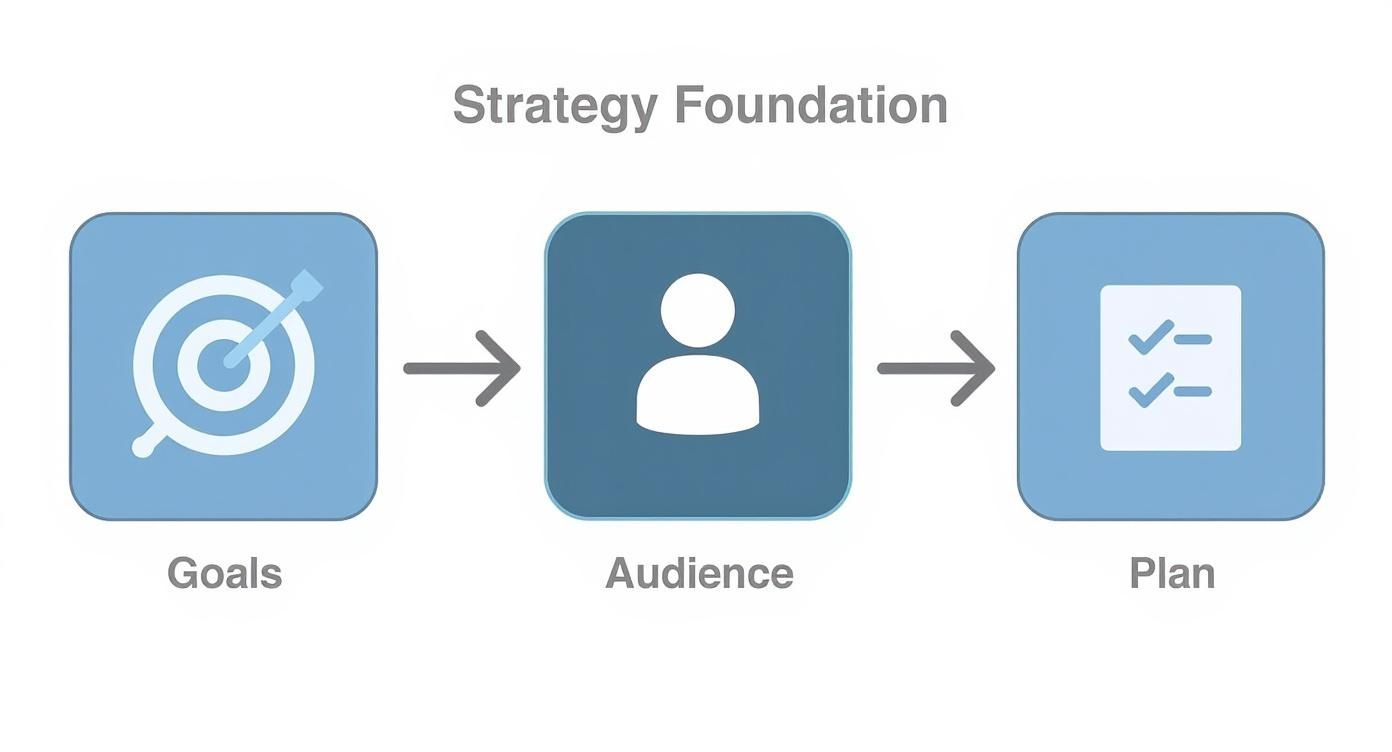
This visual guide shows how each step builds on the last, creating a stable foundation for all your future content.
And this planned approach is only becoming more important. By 2025, a huge 81% of UK marketers say that content marketing is a core business strategy. What is more, UK companies with a documented plan get a 33% higher return on investment than those without one. This shows a clear link between planning and success. To get a wider view, you can explore strategic content insights that cover this topic from many different angles.
Finding and Organising Your Content Ideas

Coming up with fresh content ideas can often feel like you are staring at a blank page, especially when the pressure is on. You are not alone in this; making new ideas all the time is a top challenge for 35% of UK marketers. But the good news is you do not have to wait for a flash of inspiration.
With the right system, you can build a library of fantastic ideas that will keep your content pipeline full for months. The best part? The most powerful ideas usually come from simply listening to what your audience is already telling you. When you listen to their challenges and questions, you can create content that genuinely helps. This builds trust and makes you the go-to expert.
Tap into Your Audience's Real Questions
Really effective content solves a problem or answers a nagging question. Your first job is to find out what those questions are. Luckily, your customers leave clues everywhere.
A great place to start is with some basic keyword research. You do not need to be an SEO expert. Free tools like Google's Keyword Planner can show what people are actually typing into search engines. Pay close attention to phrases that start with "how to", "what is", or "why does". These are direct signs that someone needs help.
For example, we worked with a client in the removals business who discovered that "how to pack kitchen items for moving" was a common search query. We helped them create a detailed video and a printable checklist on that exact topic. It shot to the top of their most popular content because it directly solved a major headache for their customers.
Another goldmine for ideas? Your own team. The daily conversations happening within your business are very valuable.
Chat with your sales team: What are the most common questions they get from prospects? What objections come up time and again?
Listen to your customer service staff: What issues are customers constantly calling about?
Check your social media comments and direct messages: What are people asking about in your community?
These conversations are full of the exact language your audience uses to describe their problems. This insight is vital for creating content that truly connects and is a key part of developing accurate customer profiles. To dig deeper into this, have a look at our guide on how to create buyer personas.
Organise Your Ideas with a Content Calendar
Once you start looking, you will find ideas popping up all over the place. The next challenge is putting them into an organised system. This is where a content calendar becomes your new best friend.
A content calendar is much more than just a schedule. It is a strategic tool that helps you plan ahead, keep a consistent publishing rhythm, and align your marketing efforts with key business dates. You do not need fancy software to get started, either. A simple spreadsheet works wonders.
A well-organised content calendar turns random acts of content into a deliberate, effective strategy. It stops you from scrambling for ideas at the last minute and makes sure every piece of content has a clear purpose and a place in your plan.
Here is what your basic calendar should track for each idea:
Working Title: A clear, draft headline for the piece.
Content Format: Is it a blog post, video, infographic, or social media update?
Key Topics: What are the main points you will cover?
Target Persona: Who, specifically, is this content for?
Business Goal: What objective does this support (e.g., generate leads, build brand awareness)?
Publish Date: When is it scheduled to go live?
Organising your content this way has some serious benefits. It stops you from accidentally repeating topics and helps you quickly spot gaps in your strategy. You might look at your calendar and realise you have not created anything for one of your key customer personas in a while.
Ultimately, this system transforms idea generation from a stressful, one-off task into a continuous, manageable process. You will build a bank of relevant topics, ensuring you always have something valuable to share with your audience. This consistency is vital, especially when 45% of UK marketers say generating quality leads is their biggest challenge. You can explore the full report on content marketing trends to see what other hurdles marketers are facing.
Creating Content Your Audience Actually Wants

You have got a solid list of ideas and a calendar to keep you on track. Now for the fun part: actually making the content. This is where the old saying ‘quality over quantity’ really matters. One brilliant, genuinely helpful article that solves a real problem is worth ten quick posts that vanish without a trace.
The real goal here is to build trust. When your audience sees that you consistently share valuable information without a hard sell, they start to see you as a credible, reliable expert. That is the foundation of any strong customer relationship.
Choosing the Right Format for Your Idea
Not every idea is meant to be a blog post. In fact, forcing an idea into the wrong format is one of the fastest ways to lose your audience's attention. The key is to think about the topic itself and then consider what format would be most helpful for the person using it.
For instance, we once worked with a client who sells specialist cleaning products. They had a fantastic idea for a piece about 'removing tough stains'. Instead of just writing a blog post describing the process, we helped them create a series of short, 30-second videos for social media. Each one showed a different common stain disappearing like magic. Seeing it happen was far more powerful than just reading about it.
Here are a few popular formats and my take on when to use them:
Blog Posts: The workhorse of most content strategies. Perfect for in-depth explanations, answering common questions ('how to...', 'what is...'), and sharing industry news.
Videos: Unbeatable for tutorials, product demos, customer testimonials, and behind-the-scenes looks at your business. Video adds a human touch that text cannot always match.
Case Studies: Very important for showing potential customers how you have helped others achieve their goals. They offer powerful social proof that your product or service delivers on its promises.
Infographics: A brilliant way to present data, statistics, or complex processes in a simple, visual format. They are also highly shareable, especially on platforms like Pinterest and LinkedIn.
Your best content will directly address a customer’s pain point in the most helpful format possible. Always ask yourself, "What is the easiest and most effective way for my audience to understand this?"
Once you have settled on the right formats, you can start bringing your ideas to life. If you want to get better at the details of content creation, there are some fantastic resources out there that can help you master the different styles.
Write Like a Human, Not a Corporation
How you write is just as important as what you write about. Your content must be easy to read and understand. As a rule of thumb, we always aim for a reading level a 12 or 13-year-old could comfortably understand. This is not about dumbing things down; it is about being clear.
Forget the corporate jargon and stuffy, formal language. Just write as if you were explaining something to a friend over a coffee. This friendly, conversational tone makes your content much more approachable and encourages people to stick around.
A few tips we swear by in our own team:
Keep sentences short and sharp. Try to stick to one main idea per sentence.
Break up your text. Walls of text are scary. Use short paragraphs, headings, and bullet points to make the page easy to scan.
Read it out loud. This is the single best trick for checking if your writing flows naturally. If it sounds clunky or awkward when you say it, it will be even more awkward to read.
This simple approach makes sure your valuable expertise is accessible to the widest possible audience.
A Quick Primer on SEO Basics
Search Engine Optimisation (SEO) sounds technical, but at its heart, it is just about helping your content get found by the right people on search engines like Google. The basics are surprisingly simple and can make a massive difference.
At its core, SEO is about understanding the words and phrases your audience is searching for (known as keywords) and weaving them into your content. If you have done your customer research properly, you should already have a good list of these.
The most important rule? Use your keywords naturally. Never try to cram them into sentences where they do not belong. Your priority should always be to write for humans first, search engines second.
A well-written headline is also vital. It needs to grab a reader's attention while also including your main keyword, ideally near the beginning. For example, a headline like "How to Create a Content Marketing Strategy for Small Businesses" works well because it is clear, tells the reader exactly what to expect, and contains that all-important keyword phrase.
Getting Your Content Seen by the Right People
It is a great feeling to hit ‘publish’ on a brilliant piece of content, but your work is not over. In fact, that is only half the job.
If nobody sees what you have created, it cannot possibly help your business grow. This is where a smart distribution plan comes in. It transforms your content from a hopeful shot in the dark into a targeted tool for growth.
Getting your content in front of the right people is just as important as the quality of the content itself. You need a clear plan for promoting every single piece you make. Without one, you are just crossing your fingers and hoping people stumble across it. A solid plan makes sure your hard work pays off by reaching the audience it was designed for.
Choosing the Right Channels for Your Business
There are countless ways to share your content, but do not fall into the trap of thinking you need to be everywhere at once. The real key is to focus your efforts on the channels where your ideal customers actually spend their time. For most UK businesses, this usually means having a solid plan for social media, email marketing, and search engines.
It is all about being strategic. Think about where your audience is most active and most likely to engage with your message. If you are a B2B company selling software, for example, LinkedIn is probably a much better bet than TikTok. On the other hand, a local restaurant would likely get fantastic results from visual platforms like Instagram and Facebook.
Do not just post your content and hope for the best. A thoughtful distribution strategy makes sure your valuable content actually connects with the people who need to see it, turning your efforts into real business results.
Understanding these channels is the first step. Each one offers a unique way to connect with potential customers, so let us break them down.
Using Social Media Smartly
Social media is a huge part of any modern content plan. It is a powerful way to share your work, engage with your community, and drive people back to your website. But with so many platforms out there, it is easy to feel overwhelmed.
My advice? Choose one or two platforms and do them really well, rather than spreading yourself too thinly across five or six.
LinkedIn: This is the absolute go-to for B2B companies. It is perfect for sharing industry insights, case studies, and professional articles.
Instagram & Facebook: These are fantastic for businesses with a strong visual element, think retailers, artists, or cafés. They are ideal for sharing photos, short videos, and behind-the-scenes stories.
X (formerly Twitter): Still a great place for sharing breaking news, quick tips, and joining in with trending conversations in your industry.
The investment in these platforms is growing incredibly fast. The UK social media advertising market is expected to hit £9.95 billion by 2025, a figure that shows just how vital these channels have become. If you are curious, you can discover more insights about UK social media trends to see how the market is changing.
The Power of Email Marketing
While social media is great for reaching new people, email marketing is your direct line to your most engaged audience. These are people who have already raised their hand and shown an interest in what you do by signing up for your newsletter.
Email is a brilliant way to deliver your latest blog posts, videos, or guides directly to people who genuinely want to hear from you. We have seen this work wonders for our clients. For one mortgage broker, we helped create a monthly newsletter that shared helpful tips for first-time buyers. This simple act of sharing valuable content built a huge amount of trust, kept their brand top-of-mind, and led to a noticeable increase in enquiries.
Do Not Forget About SEO
Finally, never underestimate the power of search engine optimisation (SEO). It might sound technical, but the basics are really just about making it easy for search engines like Google to find and understand your content.
This means including relevant keywords naturally in your writing, creating helpful headlines, and making sure your website is a breeze to use. Good SEO makes sure your content can be discovered by people actively searching for solutions, weeks, months, or even years after you publish it.
It is a long-term game, but one that delivers a consistent, reliable flow of traffic over time. If you want to get a better handle on this, we have written a complete guide on what SEO is and how it works.
Measuring What Matters in Your Content Strategy

You have poured time and effort into creating and sharing brilliant content. So, how do you actually know if it is working? The only way to find out for sure is to measure its performance.
Diving into data can feel a bit scary, but it does not have to be. It is really just about checking if your efforts are hitting the goals you set at the beginning. If you are not measuring, you are just guessing.
Tracking a few key numbers helps you make smarter decisions. It is your roadmap, showing you what your audience loves so you can create more of it, and what they are ignoring so you can stop wasting valuable time.
Key Metrics You Should Be Tracking
The first time you open up a tool like Google Analytics, the huge amount of data can feel overwhelming. The secret is to ignore the noise and focus on a handful of metrics that truly show the health of your content strategy.
For most small businesses, the numbers that matter fall into a few core groups. Together, they tell a story, from how people find your website to what they do once they get there. Understanding this story is what allows you to improve.
Here are the key metrics we always focus on with our clients:
Website Traffic: This is your starting point. How many people are actually finding and visiting your site? Check the ‘Users’ and ‘Sessions’ reports in Google Analytics to get a clear picture.
Traffic Sources: This tells you how visitors are getting to you. Are they coming from Google (organic search), social media, or your email newsletter? This is vital for knowing which promotional channels are working hard.
Average Time on Page: A fantastic indicator of how engaging your content is. If people are sticking around for several minutes on a blog post, that is a huge sign that they find it genuinely valuable.
Conversion Rate: This is possibly the most important metric of them all. It tracks how many visitors take the action you want them to, whether that is filling out a contact form, signing up for your newsletter, or downloading a guide.
Measuring performance is not about collecting data for the sake of it. It is about gathering insights that help you make better decisions, refine your strategy, and prove the value of your content to your business.
Each of these numbers is a clue. Consistently low traffic might mean your promotion needs a rethink, while a low average time on page could suggest your content is not hitting the mark.
Using Data to Improve Your Strategy
The real magic happens when you use this information to make positive changes. Your data should directly guide your future content decisions, helping you build a smarter, more effective plan.
Think of it as a simple feedback loop: create, measure, and then use those results to inform what you create next. This cycle is at the very heart of every successful content marketing strategy I have seen.
Let us say you notice in your analytics that one of your blog posts is bringing in a huge amount of traffic from Google. That is a massive clue from your audience. It tells you the topic is something people are actively searching for and that your SEO on that piece was spot on.
What is the next logical step? Double down on that success. You could write a more in-depth follow-up post, create a short video explaining the concept, or design a downloadable checklist. This approach makes sure you are focusing your energy on proven winners.
Free Tools to Get You Started
You absolutely do not need an expensive suite of tools to start measuring your content’s performance. In fact, you can get all the essential insights you need completely free.
Here are the tools we recommend every small business starts with:
Google Analytics 4: This is the industry standard for tracking website traffic and user behaviour. It will tell you who is visiting, how they got to your site, and which pages they are looking at.
Google Search Console: This tool is all about your website's performance in Google search. It shows the keywords bringing people to your site and flags any technical issues that might be holding you back.
Built-in Social Media Analytics: Every major platform (Facebook, Instagram, LinkedIn, etc.) has its own free analytics dashboard. Use these to see how your individual posts are performing and which type of content gets the most engagement.
By checking these tools regularly, you will build a clear picture of what is working and what is not. For a deeper dive, check out our guide on how to measure marketing campaign success. This will help you make confident, data-backed decisions to continually improve your results over time.
Got Questions About Content Strategy? You are Not Alone.
When you first dip your toes into content marketing, it is normal for a million questions to pop into your head. Believe me, we have heard them all from businesses trying to find their footing. Nailing the basics right from the beginning can save you a world of headaches later on.
So, I have pulled together some of the most common questions we get asked. These are not textbook answers; they are practical insights drawn from over 200 real-world projects.
How Often Should I Be Publishing New Content?
Ah, the million-dollar question. If I had a pound for every time I have been asked this. The honest answer is: there is no magic number.
Consistency is much more important than frequency, every single time.
Seriously. It is far better to publish one fantastic, well-promoted blog post each week than to churn out three average articles that just gather dust.
Start with a pace you can genuinely maintain. If that is one solid blog post a month and a couple of social media updates a week, brilliant. That is your foundation. Once you get into a rhythm, you can think about doing more, but never, ever let quality slide.
Should I Outsource My Content Creation?
This is a classic problem for small businesses. On one hand, nobody understands your business and your customers quite like you do. That is a huge advantage. On the other hand, creating great content takes a serious amount of time, time you probably do not have.
Bringing in a freelancer or an agency can be a game-changer if you are stretched thin or writing just is not your strong suit. It frees you up to actually run your business. The trick is to find a partner who is willing to really dig in and understand your brand's voice and your audience. Always ask to see their portfolio.
A great content partner should feel like an extension of your own team. They need to be as invested in your business goals as you are, ready to help build a content strategy that actually delivers.
If you have a bit of budget, a mix of both can be the perfect middle ground. Maybe you handle the daily social media chatter yourself but outsource the bigger items like blog posts, ebooks, or case studies. This gives you a nice balance of in-house control and expert support.
What is the Difference Between Content Strategy and SEO?
This one trips a lot of people up, but it is simpler than you think.
Imagine you are planning a road trip. Your content strategy is the map. It decides your destination (your goals), your route (the topics), and who you are taking with you (your audience).
SEO, on the other hand, is the car that gets you there. It is all the practical stuff: choosing the right fuel (keywords), following the road signs (on-page optimisation), and making sure your engine is tuned up (technical SEO) so you actually arrive.
The two are completely linked. A brilliant strategy is useless if no one can find the content. And all the SEO in the world will not help if your content is rubbish when people get there. You need both to work together to get anywhere.
At Milktree Agency, we help UK businesses like yours build and execute content strategies that turn visitors into enquiries. If you are ready to create a plan that drives real growth, let us talk. Start with a free audit to see how we can help. Find out more at https://milktreeagency.com.