
When you're looking for affordable website design in the UK, the real goal is to find that perfect spot between cost and quality. You need a website that not only looks professional but actually helps your business grow. For many small businesses, this can mean anything from a DIY website builder at around £10 per month to a custom-built site from an agency, which often starts from £3,000. The right choice really comes down to what you need your website to do for you.
Finding the Balance: Cost vs. Quality in UK Web Design
Getting a new website can feel like a big expense, especially when you are just starting out. But ‘affordable’ should not mean ‘cheap’ or useless. It is all about making a smart investment that gives you a good return.
The cost for a small business website from a UK agency often falls somewhere between £3,000 and £6,000. On the other hand, if you are on a very tight budget, you can get a site running on platforms like Wix or Squarespace for as little as £1 to £35 a month.
This choice between going it alone with a builder or hiring a professional is a crossroads we see businesses at all the time. To be honest, both options have good points.
Your Main Options for a New Website
DIY Website Builders: Think of platforms like Squarespace or Wix. They are great for simple sites or if you are just starting with a tiny budget. You pick a template that looks good and then add your own words and pictures.
Freelance Web Designers: Hiring a freelancer can be a fantastic middle ground. You get a website that is much more personal than a template allows, but usually for less than you would pay a full agency. This is ideal if you need something a bit more unique but do not have a massive budget.
Web Design Agencies: Working with an agency (like us) is the best choice when your website is a vital tool for your business. This gets you a whole team of experts in design, development and marketing. They all work together to build a site that attracts customers.
The key is to find the right balance for your business. A cheap website that fails to bring in any customers is a wasted investment. But spending too much on complicated features you will never use is not a wise use of your money either.
To give you a clearer picture, here is a quick summary of how these options compare for most UK small businesses.
UK Website Design Options At A Glance
Design Option | Typical Monthly Cost | Best For |
|---|---|---|
DIY Website Builder | £10 - £35 | Start-ups, sole traders, or businesses needing a simple online brochure. |
Freelancer | £50 - £150+ (Est.) | Businesses needing a custom design on a moderate budget. |
Web Design Agency | £150 - £500+ (Support) | Established businesses where the website is a key driver of leads and sales. |
In the end, understanding where your money goes is the first step toward making a decision you can feel good about. A well-planned website is an asset that should pay for itself over time. In fact, it is the core of any successful marketing strategy for small businesses, acting as the central hub for all your online activities.
What Really Affects Your Website Design Costs
Have you ever looked at two web design quotes, one for £1,000 and another for £10,000, and wondered what was going on? It is not just agencies pulling numbers out of thin air. The price you are quoted reflects the time, difficulty and specific skills needed to create your website.
Think of it this way: a simple, five-page brochure site for a local plumber is a very different project from a busy online shop with hundreds of products. The more features and custom work you need, the more hours a designer has to put in.
Having built over 200 websites for UK businesses like yours, we see the same things affecting the cost time and time again. Let's look at what they are.
The Biggest Price Influencers
The size of your project is the single biggest factor that affects the final price. It all comes down to a few key areas:
Page Count: It is simple maths. A website with five main pages (like Home, About, Services, Blog, Contact) is much faster to build than one with twenty pages. Each of those extra pages needs its own layout, content and design.
Special Features: Do you need a booking system for appointments? A gallery to show your work? Or maybe a private login area for members? Each of these special features adds extra work, often needing more development time and special tools.
Ecommerce Functionality: This is a big one. The moment you decide to sell products online, your website becomes much more complex. You will need product pages, a shopping basket, a secure checkout process and a way to take payments.
If you are thinking about an online shop, it is worth understanding the costs for that platform. For a detailed look at how different features add up, this is a clear cost guide for a Shopify store.
Custom Design vs Templates
Another major choice you will face is between a completely unique, custom-built design and a pre-made template.
A template-based website is a bit like buying a suit off the rack. It is faster and much more affordable because the basic structure is already there. The agency's job is to then change it with your branding, colours, logo and content. For many small businesses, this is a brilliant, low-cost way to start.
A custom design, on the other hand, is like getting that same suit made to measure. It is created from scratch to perfectly fit your brand, your audience and your business goals. This involves a lot more planning, design work and development, which naturally costs more. The result is a website that is 100% unique to you.
We often advise clients on a tighter budget to start with a professional, well-chosen template. You can always invest in a full custom design later on as your business grows.
Of course, how quickly you need the website can also affect the final price. If you are curious about how long the whole process might take, you can get a good idea from our guide on how long it takes to build a website.
Understanding these things puts you in a much stronger position. You will be able to have a better conversation with any designer and know exactly what you are paying for.
How to Find a Good, Affordable Web Designer
Choosing the right person or agency to build your website is a huge decision. It is tempting to go for the lowest price. But I have seen how a badly built website can cost a business much more in the long run. We are talking about lost customers and spending more money just to fix problems.
Finding a skilled, reliable web designer who fits your budget is possible, though. It just takes a little homework. The goal is to find someone who understands your business and can deliver a great website that does its job.
Look Beyond the Price Tag
Your first step should always be to look at their past work. A designer’s portfolio is the best proof of their skill. Do the websites they have built look professional? Are they easy to use? And do they have experience working with businesses like yours in the UK?
Look for variety in their work. If every site in their portfolio looks the same, they might just be using the same template over and over. A good designer can change their style to fit different brands.
Do not just look at the homepage. Click through a few of their portfolio sites. Try them out on your phone. A pretty website that is hard to use is a waste of money.
Check Their Reputation and How They Communicate
Next, look for reviews and testimonials. What are other small business owners saying? Look for comments about the process, not just the final design. Were they easy to work with? Did they stick to deadlines and the agreed budget?
Clear communication is vital. From the very first email or phone call, you should feel like they are really listening. A great partner will ask you lots of questions about your business goals before they talk about colours and fonts. This early work stops major problems later on. As a marketing agency in Southampton, we know that understanding a client's local market is key to their success.
The UK web design industry is very competitive. This means that while you can find some great prices, some designers may be tempted to cut corners on service.
This decision tree gives you a rough idea of the main things that affect your website's cost.
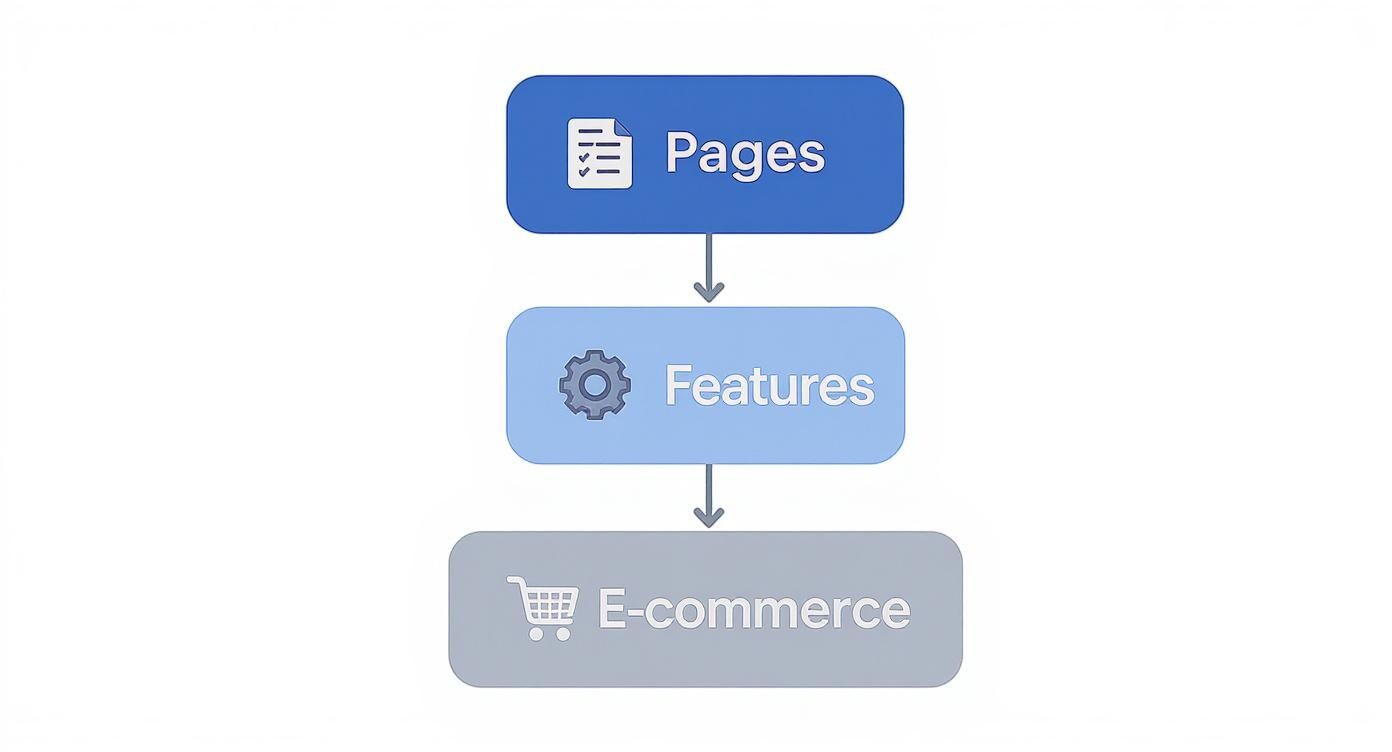
As you can see, adding features like an online shop will have the biggest impact on the final price.
Questions to Ask Before You Commit
Before you sign any contract, make sure you get clear, simple answers to a few key questions. This one step can save you a lot of trouble.
What, exactly, is included in the price? Ask about hosting, domain names and any ongoing support fees.
Can I update the website myself? You need to be able to change basic text and images without calling (and paying) a developer every time.
Who owns the website when it’s finished? The answer must always be you. There are no exceptions.
What happens if I’m not happy with the design? Get a clear idea of the revision process and how many rounds of changes are included.
To keep costs down without losing quality, many businesses use one of the best website builders for small businesses. This can be a great option if your budget is very tight. Taking the time to find the right person for the job will really pay off.
Making Your Budget Work Harder Without Cutting Corners
Even with a small budget, a brilliant website is possible. The secret is not about finding the cheapest price. It is about spending your money on the things that give you the biggest return. It all comes down to making smart choices.
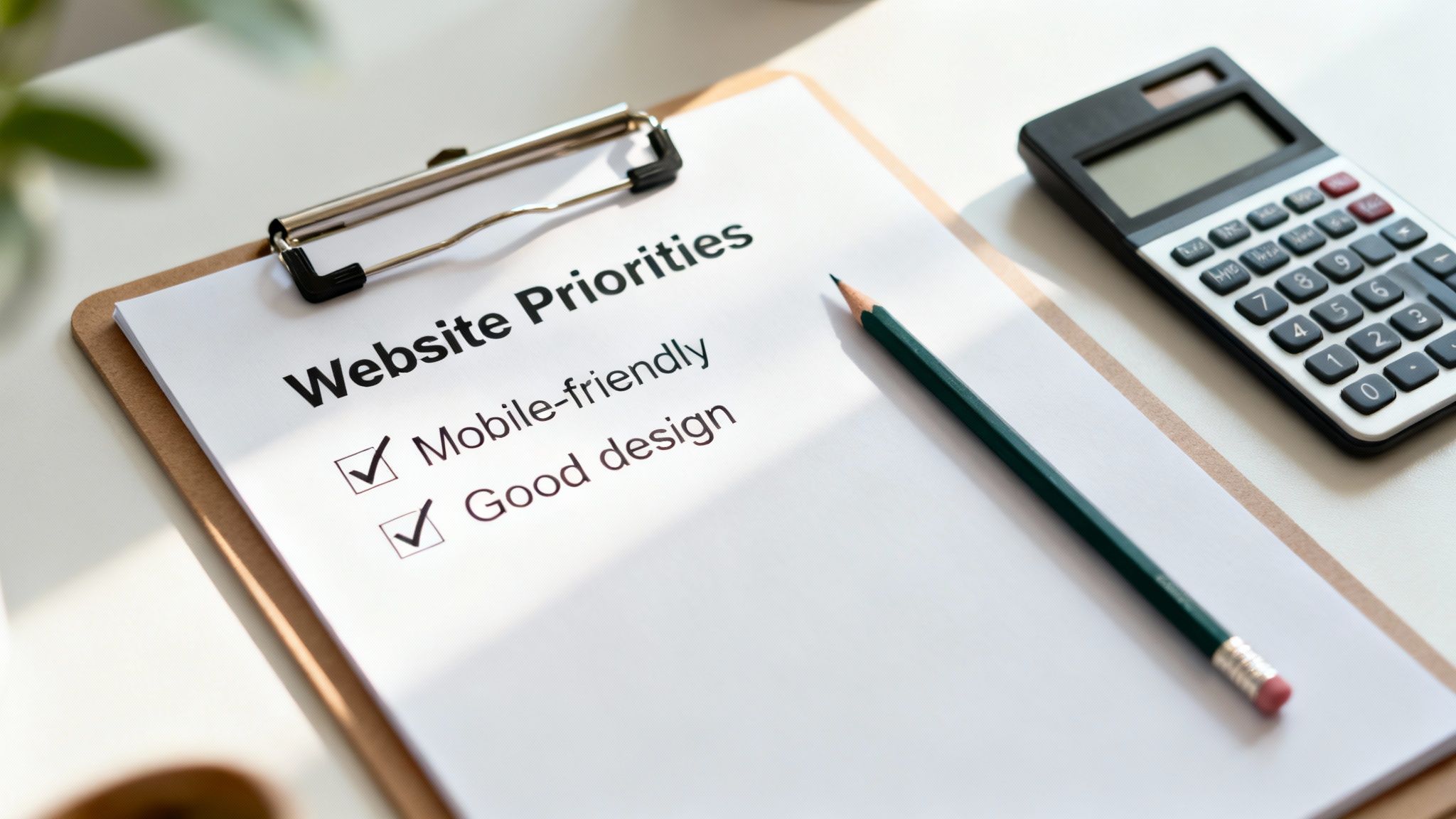
Having guided over 200 clients through this process, we have learned what really matters. Our most common advice is to focus on the user experience. That means investing in a clean, professional design and making sure the site works perfectly on mobile phones.
These are the things that directly affect whether a visitor stays, trusts you and decides to get in touch. Get these right, and you have built a strong foundation for growth.
Where to Invest and Where to Save
So, how do you stretch your budget for an affordable website design in the UK without losing quality? It is a bit of a balancing act. The key is to focus your spending on what will make a real difference to your business from day one.
Here are a few practical tips we always share with our clients:
Invest in Design & Mobile: A visitor forms an opinion about your business in seconds, based only on your site's design. If it looks old or is hard to use on a phone, you will lose customers straight away.
Save by Starting Small: You probably do not need a huge 20-page website right away. Launching with just three to five key pages (like Home, About, Services and Contact) is a great way to get online quickly and keep costs down. You can always add more later.
Plan Your Content: This one is huge. Giving your designer all your text and images at the start saves a lot of back-and-forth emails. This saves them time, which saves you money.
The goal is to build a simple, effective website that does the basics brilliantly. Avoid being tempted by flashy features you do not really need at the start. You can always add things like a booking system later on.
The Power of Smart Design Choices
Smart design choices are about more than just how a site looks. They directly affect how well your site turns visitors into customers. For example, something as simple as focusing on clear calls-to-action (CTAs) can have huge results. Well-placed buttons that tell users what to do next can really improve your number of enquiries.
The impact here is very real. In fact, research shows that personal CTAs on UK websites can increase visitor conversions by around 42%. This shows how clever design, even on an affordable website project, delivers a proper financial return.
If you are interested in the data behind this, these UK web design statistics offer some great information about how design affects user behaviour. It proves that clever, focused design is one of the smartest investments you can make.
The Hidden Costs of a Cheap Website
That very low price for a new website can seem really tempting, I understand. But I have been in this business long enough to see the problems that follow. Trust me, the cheapest quote often ends up being the most expensive choice in the long run.
Think of it like buying a dodgy used car. It looks fine at first, but a few months later you get a huge bill for a new gearbox that costs more than the car itself. A cheap website can be just like that: a small initial saving that quickly turns into a major, ongoing headache.
One of the biggest traps we see small business owners fall into is the lack of Search Engine Optimisation (SEO). A bargain website is usually thrown together in a rush, with no thought for how it will show up on Google. The result? A website that might look okay, but nobody will ever find it.
Problems That Creep Up Later
A badly built website will drain your money in ways you do not expect. That initial low price is a hook, but the total cost of owning the site can spiral out of control.
Here are a few of the "hidden extras" we often see people get caught out by:
Expensive Maintenance: Some developers attract you with a low build price, only to charge high monthly fees for the smallest updates. You end up trapped, unable to change a phone number without paying them more.
Serious Security Risks: To keep costs down, cheap websites often cut corners on security. This leaves your site (and maybe your customers' data) open to hackers. Cleaning up a hacked website is not just expensive, it is also very stressful.
No Control for You: One of the most common problems is being given a website that you cannot update yourself. If you have to pay a developer every time you want to add a new photo, those small costs add up very fast.
The true cost of a bad website is not just the money you spend fixing it. It is the lost business from customers who could not find you online or were put off by a slow or unprofessional site. That is the cost that really hurts.
The Invisible Cost of Bad SEO
Perhaps the most damaging hidden expense is poor SEO. If a website is not built with search engines in mind from the start, it is going to be a constant struggle to get it ranking on Google for what your customers are searching for.
Basically, your website becomes invisible.
Investing in a proper build from the beginning means your site has the solid foundation it needs to do well. If you are new to the topic, you can learn the basics from our simple guide on what is SEO and how it works.
When you are looking for affordable website design in the UK, it is vital to look beyond that initial price. Ask tough questions about ongoing costs, security and who has control over updates. Getting clear answers will save you from a lot of nasty surprises and make sure your investment pays off.
Getting Your Web Design Project Started Right
You have found a designer you trust and agreed on a price. Fantastic. But the success of your project now depends on one crucial thing: good preparation.
Getting organised before the work starts is the single best way to keep everything running smoothly, on time and on budget. Think of it as a partnership. Your designer brings the technical and creative skills, but you bring the deep knowledge of your business, your customers and what you are trying to achieve. The clearer you are, the better the final website will be.
This all starts with a simple but effective design brief.
Writing a Simple Design Brief
A design brief does not need to be a huge, complicated document. It just needs to clearly explain what you want. See it as a set of instructions for your designer, covering the important things they need to know before they start.
As a minimum, your brief should cover:
Your Goals: What is the main purpose of this website? Is it to get more phone calls, sell products, or show your work? Be specific. "Get 10 new plumbing leads a month" is much better than "get more business".
Your Audience: Who are you trying to reach? Write a quick description of your ideal customer. This helps the designer make choices about colours and language that will connect with them.
Websites You Like: List a few websites you like and explain why you like them. Is it the clean layout? The photos? This gives your designer a real feel for the style you want.
A good brief saves you time and money. It reduces the back-and-forth emails and makes sure everyone is on the same page from day one. Taking an hour to write this down is one of the best investments you can make in the project.
Getting Your Content Ready
Here is a bit of inside knowledge for you: the biggest delay in almost every small business web design project is waiting for content from the client. It happens all the time.
To avoid this common problem, get your key materials organised before your designer even opens their laptop. This is your side of the partnership, and it is what keeps an affordable website design UK project from getting out of control.
Aim to have the following ready to give them:
Your Logo: Make sure you can provide this in a high-quality format. A vector file (like an .eps or .ai) is the best option if you have one.
Website Text: Have a go at writing the text for your main pages, like Home, About, Services and Contact. It does not need to be perfect. Your designer can often help improve it.
Images and Photos: Collect any professional photos you have of your team, your work or your products. The key here is to make sure they are high-resolution. Blurry photos can ruin a great design.
Being prepared with all this content means your designer can start work right away, turning your vision into a reality without any frustrating delays.
Your Questions, Answered
Finding that perfect spot between a professional website and a realistic budget can feel tricky. Let's answer some of the most common questions we get from UK business owners just like you.
How Much Should I Actually Budget for a Small Business Website in the UK?
This is the big question, is not it? The honest answer is: it varies a lot.
You could go the DIY route with a platform like Squarespace and spend as little as £10 a month. On the other hand, a good freelance designer will likely quote you somewhere in the £1,000 to £3,000 range. If you go to a small, specialised agency, you are usually looking at a starting price of around £3,000.
The key is to let your business goals guide your budget. If you just need a simple, professional online brochure, a lower-cost option is fine. But if you are relying on your website to generate leads, investing more in expert design and SEO from the start is one of the smartest moves you can make.
Can I Realistically Get a Good Website for Under £1,000?
Yes, you can. You just need to be very clear about what you are getting for that price.
For a budget under £1,000, you will almost certainly be getting a website built on a pre-existing template, not a completely custom design from scratch. It will likely be a simple site with just a few main pages.
For a new business or a start-up, this can be a great way to get online quickly and professionally. Just make sure you get a detailed list of what is included before you agree to anything.
A word of caution: a cheap website that looks unprofessional or does not bring in a single customer is not a saving. It is a wasted opportunity. Always check a designer's portfolio to see the quality of their work before you commit.
What's More Important: The Price Tag or the Designer's Portfolio?
This one is a classic, but the answer is quite simple. While your budget is a real-world limit, the portfolio gives you the clearest picture of the value you will receive. The price tells you if you can afford them, but their past work shows you what you will actually get for your money.
My advice? Always start with the portfolio.
If you find a designer whose work you love and it perfectly matches your vision, then you figure out if the price works. It is much better to find a designer whose quality you trust and try to meet their price, than to simply pick the cheapest quote and hope for the best.
Ready to get a professional website that actually brings in enquiries, without costing a fortune? The team at Milktree Agency builds high-performing websites from just £799. Let's have a chat about what you need.